
How the Divide Became the Default
Before proceeding, read my note 1 for additional context.
The Renaissance and Reformation overlapped. Within fifty years, the European Church changed radically and permanently—not because of a single cause, but because of converging forces: humanism, failed internal reforms, geographic expansion, printing and vernacular Bibles, emerging nation-states, urbanization, a growing merchant class, and tensions between northern and southern Europe.
The immediate catalyst in Germany was the sale of indulgences. On October 31, 1517, Martin Luther challenged that system in his Ninety-Five Theses, igniting the Protestant Reformation. 2
Political self-interest accelerated its spread. Henry VIII seized ecclesiastical authority in England, while German princes supported Luther for both religious and political reasons. The Peace of Augsburg in 1555 allowed each German ruler to choose Catholicism or Lutheranism for his territory, further weakening papal authority. 3
Yet the Reformation’s central concern was theological: the authority of Scripture, the priesthood of all believers, and freedom of conscience. Printing, humanism, and political opportunity amplified convictions that permanently transformed European Christianity. 4
The Reformers retained belief in the autonomy of God’s grace and the biblical teaching that the Fall touched all of life. Final authority therefore rested in Scripture alone—not Scripture plus human authority. Nor could man achieve salvation through Christ’s merit supplemented by his own.
For the Reformers, Christ’s work in space, time, and history was actual, substitutionary, and sufficient. Man approaches God empty-handed, receiving salvation by grace through faith alone.
Thus, unity remained. Scripture still spoke authoritatively about God, man, and life; Christ’s finished work was sufficient for salvation. It was Scripture alone and faith alone, to the glory of God alone. Man, created in God’s image and redeemed by grace, possessed dignity and participated in creation as God’s steward.
The biblical worldview begins with God: “In the beginning, God.” Everything has unity, symmetry, and meaning because it exists under the living God, who is present and not silent. The God of the Bible is both personal and infinite. Eastern conceptions may embrace infinity but lack personality; Western gods are personal but finite and flawed—more like Marvel superheroes than gods. The biblical God alone is personal-infinite. He created everything ex nihilo, from nothing. God is the infinite Creator; everything else is finite creation. The cloud represents divine life, eternal life. This establishes one chasm between God and all he created. Below the chasm is physical life, natural life.
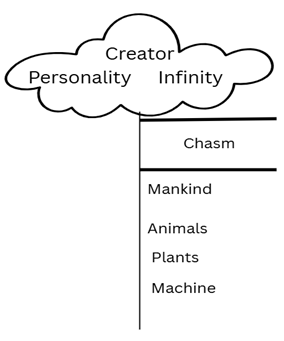
Figure 1- Francis A. Schaeffer: The Relationship Between God and Creation, from Escape From Reason.
The components of the diagram relate in this manner from highest order to lowest order:
· God – the Uncreated, Infinite, Personal Creator
· The Chasm - that which divides between the Creator and the Creation
· Man – Created, but in the image of God, living, therefore, able to fellowship with God
· Animal, Created, living, sentient
· Plant, Created, living, non-sentient
· Machine, Created, nonliving, mechanistic, shaped by natural causes
But this view is not the full vision of the worldview. It clearly establishes the chasm between the Personal-Infinite Creator and the entirety of Creation. But God did not create and withdraw, as deism proposes. He remains active within reality, working through man as his sub-regent. Because man uniquely bears God’s image, a second chasm exists between man and the lower creation—animals, plants, and the mechanical order.
The complete model of the Biblical Christian refines the model in a very significant way. The above model is not wrong, but it is not complete. It demonstrates the chasm between an infinite Creator and ALL of Creation, but there is more to it that is too important to bypass.
The God of the Bible is not merely uncreated and infinite, but also personal. The Bible, from cover to cover, shows Him actively involved in the outworkings of reality, with His sub-regent, Man. The Chasm on the personal side requires some modification. Created in the image of God adds an element to Man that is not present in “lower” creation. It is a difference in status, not in attributes. The status is unique to man and is present in both believing and unbelieving man. But the image cannot be perfected without a transformation. We are all born into natural life (below the chasm). I am reluctant to use churchy language, but it is the shortest route to understanding. I give you the example of Nicodemus, a Jewish Religious leader:
Now there was a man of the Pharisees named Nicodemus, a ruler of the Jews. … “Rabbi, we know that you are a teacher come from God, for no one can do these signs that you do unless God is with him.” Jesus answered him, “Truly, truly, I say to you, unless one is born again he cannot see the kingdom of God.” Nicodemus said to him, “How can a man be born when he is old? … Jesus answered, “Truly, truly, I say to you, unless one is born of water and the Spirit, he cannot enter the kingdom of God. That which is born of the flesh is flesh, and that which is born of the Spirit is spirit. (John 3:1–6).
A natural man can experience Kingdom (eternal) life, but “you must be born again.” That requires believing-loyalty to Jesus Christ. I will describe this transformation more fully in the next article. A 2-dimensional diagram cannot adequately represent a spiritual truth, but here is a refined model. This revised model will support the worldview presented throughout this ministry.
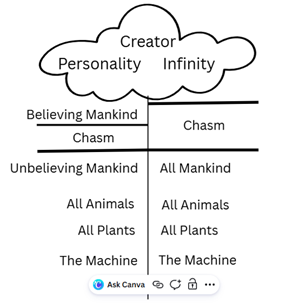
Figure 2 - Francis A. Schaeffer: The Relationship Between God/Man & Creation, adapted from Escape from Reason
For a time, the system held, but the die was cast. Ecclesiastical authority had been challenged, fault lines exposed, and humanism was gaining momentum toward naturalism. Aquinas was neither solely responsible nor entirely irrelevant to the issue. The essential point is that a shift in worldview had crept in, toward humanism, and was gaining momentum in its slide toward naturalism.
The progression of thought with respect to the relationship between God and man was not limited to the arts. Science in the West developed, in part, because of the Christian conviction that the universe was the creation of a rational God and therefore possessed an intelligible order. Nature was worth investigating because its order was real, and the human mind could hope to discover it.
As early as the 13th century, Roger Bacon, in his Opus Majus (1267), wrote a treatise for Pope Clement IV that ranged over all aspects of natural science, from grammar and logic to mathematics, physics, and philosophy. In it, he writes about “the divine wisdom by which all things are disposed.” He is famous for concluding, “There are two modes of acquiring knowledge, namely, by reasoning and experience.” In other words, reasoning may yield answers, but experience confirms them through correspondence with reality.
Johannes Kepler (1571-1630) was an astronomer, mathematician, astrologer, natural philosopher, and music theorist. He is a key figure in the 17th-century Scientific Revolution, best known for his laws of planetary motion and his books “Astronomia nova, Harmonice Mundi”, and “Epitome Astronomiae Copernicanae”. Kepler famously described his astronomical work as, in effect, uncovering the geometrical plan according to which God constructed the cosmos. That conviction wasn't ornamental theology added after he had done his astronomy. It motivated the search for mathematical regularity.
This is why Kepler kept searching when Mars's orbit refused to fit the accepted perfect-circle model. If the data and the model disagreed, the model was wrong—not nature. There was an actual order there to be found.
Galileo Galilei (1564–1642), one of the central figures of the Scientific Revolution, argued that the cosmos is a book open before humanity, but one that cannot be understood unless we learn its language:
“It is written in the language of mathematics.”
He continues that its characters are triangles, circles, and other geometrical figures. Again, the underlying assumption is profound: nature is not chaos. It possesses a sufficiently stable and rational structure that human beings can decipher it mathematically.
Rather than identifying this shift themselves, the Reformers were reacting against it. Both Catholic and Reformed positions agreed that all human authority originates in God’s sovereignty, and this unity would produce similar responses on each side to the rise of political ideologies in the eighteenth and nineteenth centuries, all of which declined to acknowledge it. 5
The Reformers resisted the shift, but the larger movement had already acquired a slow, cumulative momentum no single reform could reverse.
But truth dies a reluctant and resistant death. Isaac Newton (1642-1727), the mathematician, physicist, astronomer, alchemist, theologian, author and inventor, was a key figure in the Scientific Revolution and the Enlightenment. He held his ground. In the Principia, he looks at the mathematical organization of the solar system and concludes:
“This most beautiful system of the sun, planets, and comets, could only proceed from the counsel and dominion of an intelligent and powerful Being.”
Newton shows that this worldview continued directly into the mature Scientific Revolution.
The conviction that nature possessed a discoverable order had borne remarkable fruit. The heavens that once seemed mysterious could now be described by mathematical laws, reinforcing the expectation that the rest of creation might likewise yield its secrets to careful observation and reason.
During the century and a half between Newton and Darwin, that confidence spread from astronomy and physics into geology, chemistry, and the study of living things. But the Enlightenment was also changing the ground beneath the enterprise. Reason increasingly ceased to be regarded merely as a God-given means of understanding creation. It became the independent judge of what could qualify as knowledge. The search for laws established by the Creator increasingly became a search for natural causes that could explain phenomena without reference to the Creator.
The Enlightenment elevated reason from a ministerial tool to supreme authority over Scripture and tradition, with thinkers like Kant viewing the “enlightened” person as one who reasons autonomously without dependence on past authorities, replacing the Reformation motto of “faith seeking understanding” with “I believe what I can understand.” 6
By the time Charles Darwin entered the discussion, the question was no longer simply whether nature exhibited order, but whether the apparent design and complexity of life itself could be explained by an entirely natural process. Human autonomy had not defeated grace; it had progressively excluded grace, revelation, meaning, and the supernatural from the prevailing public account of reality. Modernism inherited the resulting division while retaining enormous confidence in human reason, science, and progress.
But the division came at a cost. A mechanical universe could supply facts, but not meaning, morality, or human dignity. Those migrated into the upper story as private values: That may be true for you, but not for me. The divide had become the default.
The zeitgeist now draws reality as:

Fig. 3. Reality as Understood by the current Zeitgeist, adapted from Escape from Reason. 7
continued as: Know the Truth And Become Free
End Notes
1 For perspective, I need to do two things. First, I need to clarify my references to God. I will, without exception, refer to God with male pronouns. This is not an arbitrary decision. The orthodox Christian position is that the original documents of the Bible, in their original languages, are the inspired, infallible words of God, written by men God chose for that purpose. This is how God refers to himself in the Bible. All the grammatical rules of the original languages (Hebrew, Koine Greek, and Aramaic) support that characterization. With all due respect, if that is the characterization that the creator of the cosmos uses to identify himself, it is nothing other than arrogance on the part of anyone who “kicks against the goads” concerning that characterization. If that offends you, then take it up with God. I didn’t “write the mail. I just deliver it.”
Secondly, I need to put a “stake in the ground” on timing. All these events coalesced at roughly the same time:
| 1509 | Calvin born | 1536 | Calvin’s Institutes published |
| 1519 | Leonardo died | 1519 | The Leipzig Disputation (Luther & Eck) |
| 1516 | Francois I invites Leonardo to France | 1536 | Calvin addresses Francis I in the Institutes |
| 1534 | Parliament’s Act of Supremacy | 1534 | The “official” birth of the Church of England |
| 1547 | Death of Henry VIII | 1547 | Francis I dies |
| 1558 | Mary I dies / Elizabeth I becomes queen | 1559 | Church of England becomes Protestant |
2 Roy E. Gingrich, The History of the Church (Memphis, TN: Riverside Printing, 1999), 49.
3 Tim Dowley and Nick Rowland, Atlas of Christian History (Minneapolis, MN: Fortress Press, 2016), 92.
4 Stephen M. Davis, French Protestantism’s Struggle for Survival and Legitimacy: 1517–1905 (Eugene, OR: Wipf and Stock, 2023).
5 David T. Koyzis, We Answer to Another: Authority, Office, and the Image of God (Eugene, Oregon: Pickwick Publications, 2014).
6 Stephen Wellum and Matthew Barrett, Christ Alone—the Uniqueness of Jesus as Savior: What the Reformers Taught…and Why It Still Matters, The 5 Solas Series (Grand Rapids, MI: Zondervan Academic, 2017), 280–281.
7 Francis A. Schaeffer, Escape from Reason, foreword by J. P. Moreland, Kindle ed. (IVP, 2014), 26.