
Know the Truth and Become Free Indeed
In the previous two articles, I outlined Francis Schaeffer’s account of how Western culture shifted from a worldview that integrated the natural and supernatural. Over the centuries, after Christ’s resurrection and ascension, that ordered reality, directed by an infinite-personal God, gave way to a view with no hope of unity. All that remains is brute nature in the lower story and autonomous (subjective) idealism in the upper story, represented as follows:

Fig. 1. Reality as Understood by the current Zeitgeist, adapted from Escape from Reason. ¹
Biblical Christianity rejects that division. It presents the natural and supernatural as dimensions of one cosmos, created and governed by God. It claims to speak not merely about private religious experience, but about the entire cosmos as it is. This model follows:
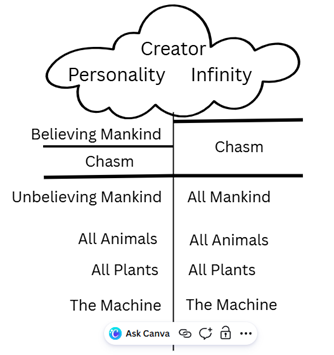
Fig. 2. Schaeffer’s Personal-Infinite Creator in relationship to Man, adapted from Escape from Reason
The chasm becomes less prominent for the man of believing loyalty to God. The chasm between Creator and creation remains. But God has lifted the believer, the man who is born again, not fully but partially and progressively, through the agency of fellowship and gradual remaking of the believer’s persona, making him increasingly more fit to be in God’s presence. In a certain sense, the believer lives in a transitional state that is both below and above the chasm. When the unbeliever converts, he becomes a new creature:
Therefore, if anyone is in Christ, he is a new creation. The old has passed away; behold, the new has come. (2 Cor 5:17).
God is not time-bound as we are. This phenomenon is both an event that has taken place (in God’s eyes) and a process as we walk it out. This is a cooperative process between God and the believer. It is not transactional in the sense of currying more favor with God. God places new desires in the believer's heart. He is a new creature, indeed, with new desires, directed at pleasing God.
It is like entering a love relationship with a spouse; for the sake of the covenant we make with our spouse, we have new desires to put them first and to please them. It is not forced; it flows from the relationship. It is the fruit of the vine. And if it is not happening, there is reason to believe the relationship is not fulfilled and/or may not be real.
The unbelieving man remains as separated as ever. This does not mean that the unbeliever has any less dignity than the believer. But it does mean he has less access to God, because his desires are still not oriented to God.
I will let the Bible explain a creation fact central to this relationship. I won’t speculate about why God did this. I will only say that it did not arise from any lack in Him. God reveals Himself as one being in three equal persons, sharing love and contentment. Job shows that His creative work began before the cosmos as we understand it.
Where were you when I laid the foundation of the earth? Tell me, if you have understanding. Who determined its measurements—surely you know! Or who stretched the line upon it? On what were its bases sunk, or who laid its cornerstone, when the morning stars sang together and all the sons of God shouted for joy? (Job 38:4–7).
These “sons of God” are angels who surround God’s throne to execute His commands, called “angels” by their office as messengers and “sons of God” by their nature.² They too are created beings, naturally disembodied spirits who can manifest physically to interact with humans. The point is that God did not create out of loneliness. He was already in fellowship within the Trinity and with His created divine family.
I am not going to lay out the full creation-of-the-cosmos story. You may go to Genesis for that. Suffice it to say, after creating the heavens and the earth, the lower orders of life, plants and animals, God created man:
Then God said, “Let us make man in our image, after our likeness. And let them have dominion over … all the earth and over every creeping thing that creeps on the earth.” So God created man in his own image, … male and female he created them. And God blessed them. And God said to them, “Be fruitful and multiply and fill the earth … and have dominion over … every living thing that moves on the earth.” … And God saw everything that he had made, and behold, it was very good. And there was evening and there was morning, the sixth day. (Ge 1:26–31).
If you read these passages as though Genesis were intended to be a modern astronomy or geology text, you miss the point. The Scientific Method has brought enormous benefit to our world, but it was designed to investigate the natural order. The mistake comes when that method is promoted from a powerful tool of inquiry to the final authority over every question of reality. That is the legacy of the Enlightenment divide we have been tracing.
Scientific conclusions properly remain open to revision as new evidence appears. That is a strength of science, not a weakness. But it is also why science cannot, by itself, serve as the final court of appeal for metaphysical questions it was never designed to answer.
Genesis is asking a different order of questions. It tells us who created reality, what kind of reality it is, who we are within it, and why we are here. The point of Genesis is to establish that God created everything that is, and that we are a special creation of God, meant to co-rule with him over creation as his ambassadors. That is our purpose in God’s eyes, and it is a calling that brings nobility and dignity to the life of every human being ever created. We are created to be the image of God – all of us.
Let me take a minute to explain what it means to be an image-bearer or ambassador of God. An ambassador is a ruler’s designated envoy, sent to represent the ruler and his government. He acts on the ruler’s behalf, carrying out the ruler’s wishes rather than his own. These are exactly the “rules of engagement” and purpose God lays out for the highest order of His creation in Genesis 1:26–31.
I don’t have space to go into full detail on imaging God; I refer you to Michael Heiser’s book, The Unseen Realm (Expanded Edition): Discovering the Supernatural World of the Bible. It is a fascinating read that will open your eyes to reality. But I will take this idea from p. 49 of the Kindle Edition. “We are created to image God, to be his imagers. It is what we are by definition. The image is not an ability we have, but a status. We are God’s representatives on earth. To be human is to image God.”
It has nothing to do with a set of attributes. Belief in God doesn’t make us more an imager of God. Lack of belief in God does not make us less an imager of God. It is our status, by virtue of creation. And that brings us back to the enemy camps we started with: an ambassador of God must reckon with God’s image even in the person standing against him.
Before I move on, another aspect of this role is essential to the worldview. God intended a familial relationship, as the ancients would have understood it. He created us to be members of His cosmic family.
The rulers of ancient Egypt were called pharaohs… The household concept for the ruling families of ancient Egypt was that of a dynastic bureaucracy. Pharaohs … frequently appointed family members to key positions of authority in their administration. … They were administrators, not lowly messengers. This concept and structure was well known throughout the ancient world. … Everyone in the system was part of the government, but authority and status were tiered.3
Heiser is describing a principle that plays out in both the supernatural and natural realms. It underscores the importance of the role God has wanted to have with mankind since the beginning.
But that relationship was broken almost immediately when man asserted his autonomy against the wishes of his Ruler, God. It was an act of treason.
Now the serpent was more crafty than any other beast of the field that the LORD God had made.
He said to the woman, “Did God actually say, ‘You shall not eat of any tree in the garden’?” And the woman said to the serpent, “We may eat of the fruit of the trees in the garden, but God said, ‘You shall not eat of the fruit of the tree that is in the midst of the garden, neither shall you touch it, lest you die.’” But the serpent said to the woman, “You will not surely die. For God knows that when you eat of it your eyes will be opened, and you will be like God, knowing good and evil.” (Ge 3:1–5).
Do you see the serpent’s appeal? Get this: it wasn’t about eating a piece of fruit. It appealed to autonomy—to come out from under God’s rule, become like God, and know good and evil independently. It was meant to drive a wedge between God and man. Acting on that appeal was treason, not merely disobedience.
Doug’s Note: Keep in mind the role of an ambassador.
Now, before you go ballistic on me, Genesis 3 is not teaching zoology any more than Genesis 1 is teaching astronomy. This is metaphorical language. ⁴ It supports—not proves—my claim that the cosmos is an integrated reality in which the natural and supernatural can and do interact.
I will make one last reference to Genesis before moving on. The immediate consequence was God calling down curses on the serpent, the woman, and the man (Gen 3:14-19). Immediately after that came God’s act of mercy.
Then the LORD God said, “Behold, the man has become like one of us in knowing good and evil. Now, lest he reach out his hand and take also of the tree of life and eat, and live forever—” therefore the LORD God sent him out from the garden of Eden to work the ground from which he was taken. He drove out the man, and at the east of the garden of Eden he placed the cherubim and a flaming sword that turned every way to guard the way to the tree of life. (Gen 3:22–24).
It may not seem like mercy because God separated them from the Tree of Life. He did it so they would not live forever in a fallen and degraded state. Remember, they are traitors against God. By separating them from the Tree of Life, he signaled that their condition would not be permanent; they would not live forever.
I am not going to lay out the entire story of Reality here. The Bible does it quite well. The map the Bible lays out, from Genesis to Revelation, shows the steps God has taken and continues to take to redeem, restore, and glorify His relationship with all of His creation, especially mankind. Remember, God's assessment after creation was: “It is very good.” He has a vested interest in redeeming what was lost.
I really want you to get this next point. It requires a new understanding of God's love.
God sends no one to eternal punishment in Hell. That is a perversion of the Christian worldview. God is holy. Mankind is unholy when left to its own devices. The entire human species is on a collision course with destruction. I don’t need to defend that statement. Any thinking person can look back through history and see that it is true.
I am the father of three. I didn’t have to teach my children to lie or put themselves first at others’ expense. It came naturally. Let me be quick to say the same is true of me. And in your heart of hearts, you know it is true of you as well; as it is written:
“None is righteous, no, not one; no one understands; no one seeks for God. All have turned aside; together they have become worthless; no one does good, not even one. Their throat is an open grave; they use their tongues to deceive. The venom of asps is under their lips. Their mouth is full of curses and bitterness. Their feet are swift to shed blood; in their paths are ruin and misery, and the way of peace they have not known. There is no fear of God before their eyes”. (Rom 3:9–18, emphasis mine).
Though he created us, we shun God. The truth is we reject God and have done so since the Garden, as a matter of course.
Now, listen carefully! Physical death is not the end. It is the soul's graduation into an eternal state. When we spend our lives demonstrating that we do not need or want God, despite what human history shows, He allows us to refuse His call to fellowship. If He forced us to come, or created us without a choice in our answer, He could rightfully be called a tyrant or puppet-maker. God wants those who willingly come. When we die, and judgment comes, the verdict follows how we chose to live, rather than God “sending” us to that fate:
And just as it is appointed for man to die once, and after that comes judgment, so Christ, having been offered once to bear the sins of many, will appear a second time, not to deal with sin but to save those who are eagerly waiting for him. (Heb 9:27–28).
He allows us to receive the reward we have demonstrated we want through the lives we live. We spend our lives ignoring and spurning him. He honors our choice of despair and isolation that we always say we want.
Much of the church has sold its birthright for the comfort of conformity and finds itself on the wrong side of the chasm in the diagram above. The chasm is real, and it is wide. We are born on the wrong side, and we stay there unless we accept God’s redemption. But we reject that rescue by stubbornly refusing the only call to eternal fellowship with Him.
On one side of the chasm is a defiant despair that we will ever find a unifying principle in knowing the truth. On the other side is the recognition that the Personal/Infinite God is still there and still very much involved in bringing about His purposes in the world. I will explain what I mean in a minute.
Wherever you look today, the new concept holds the field. The consensus about us is almost monolithic, whether you review the arts, literature or simply read the newspapers and magazines … On every side you can feel the stranglehold of this new methodology—and by “methodology” we mean the way we approach truth and knowing. It is like suffocating in a particularly bad London fog. … The tragedy of our situation today is that men and women are being fundamentally affected by the new way of looking at truth, and yet they have never even analyzed the drift which has taken place. Young people from Christian homes are brought up in the old framework of truth. Then they are subjected to the modern framework. In time they become confused because they do not understand the alternatives with which they are being presented. Confusion becomes bewilderment, and before long they are overwhelmed. This is unhappily true not only of young people, but of many pastors, Christian educators, evangelists and missionaries as well.5
This is the fate of most of the World. But it is absurdly sad that we choose to stay “outside the camp” when eternal fellowship with our living, personal, active, forgiving, loving God is offered to those who, by faith, granted by God, accept the call and are adopted into the family.
… because, if you confess with your mouth that Jesus is Lord and believe in your heart that God raised him from the dead, you will be saved. For with the heart one believes and is justified, and with the mouth one confesses and is saved. For the Scripture says, “Everyone who believes in him will not be put to shame.” For there is no distinction between Jew and Greek; for the same Lord is Lord of all, bestowing his riches on all who call on him. For “everyone who calls on the name of the Lord will be saved.” (Rom 10:9–13).
Justice demands that a Holy God be honored. The penalty for failing is death. Mercy allows forgiveness and reprieve from that penalty. The mystery of the ages is this: God satisfied both Justice and Mercy through the Second Person of the Trinity, who became man, lived a sinless life, and took the penalty of sin upon Himself for all of us at the Cross. His resurrection on the third day confirmed that Justice had been satisfied. He then ascended to heaven to rule until He returns for His believers, both the living and those who died awaiting Him.
When Christ says:
“I am the way, and the truth, and the life. No one comes to the Father except through me.” (John 14:6).
It is not a statement of exclusion. It is the most inclusive claim ever made. Jesus is saying Be at peace; despair is not the end. In other words, I AM the way. Come to me.
You will know the truth and the truth will set you free. (John 8:32)
So simple: loyal belief and confession
Get Onboard -- Today
End Notes
1 Francis A. Schaeffer, Escape from Reason, foreword by J. P. Moreland, Kindle ed. (IVP, 2014), 26.
2 Mrs. T. M. Constance, Job, Psalms, and Proverbs (Dickson, TN: Explorer’s Bible Study, 1990), 1:94.
3 Michael Heiser, The Unseen Realm (Expanded Edition): Discovering the Supernatural World of the Bible, Kindle ed. (Lexham Press, 2015, 2025), 21.
4 Michael Heiser, Was the Snake of Genesis 3 a Spiritual Being? https://www.youtube.com/watch?v=VqY_61Ziu8Q, watched 09/17/2026.
5 Francis A. Schaeffer. The God Who Is There, Foreword by Steven Garber, Kindle ed. (IVP, 1968), 21.